
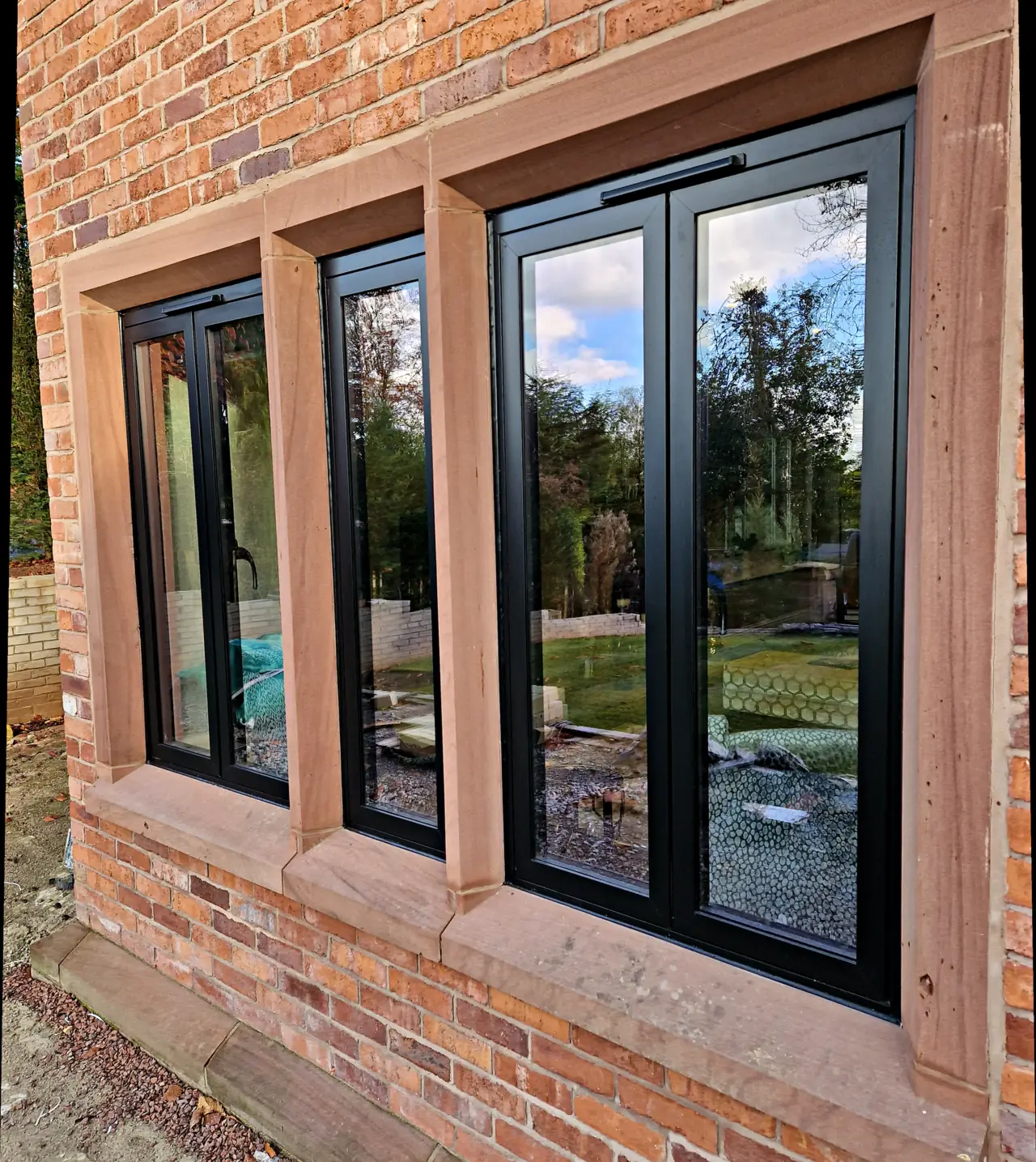
Frame strength and sightlines
Aluminium has a far higher strength-to-weight ratio than PVCu, so frame and sash sections carry more glass with less material. That gives slimmer sightlines and larger panes before you need a transom or mullion. On a wide opening it usually decides the spec.
PVCu sections are bulkier and rely on internal steel reinforcement to span. Above roughly 2.4m the steel adds weight and the sightline grows. For wide spans, tall casements or structural glazing, aluminium holds its line where PVCu starts to need extra framing.
Match the system to the opening. For large glazed runs see aluminium sliding doors and aluminium bifold doors; for slim internal screens, steel-look internal doors.
Thermal performance and the U-value route
Both materials meet current Building Regulations when specified correctly. PVCu is a natural insulator; aluminium uses a polyamide thermal break to control conduction. Judge it on the whole-window U-value, glazing and frame combined, not the centre-pane figure on its own.
In England, replacement windows in dwellings are expected to meet a maximum whole-window U-value under Approved Document L, with a centre-pane route where heritage appearance limits the frame. Confirm the operative edition and the target figure with building control before you order, since the guidance is being revised.
Specify the U-value against the actual frame, glass unit and spacer. See energy efficiency for how the build-up changes the result.
Ventilation and security to check
Where you cut opening area, Approved Document F can require background ventilation to be maintained, often via trickle vents sized by equivalent area. A night-latch position is not an accepted ventilation route. Check the existing provision room by room before swapping like for like.
On security, ask for the PAS 24 route and the locking specification, not the material alone. Aluminium and PVCu can both be specified to PAS 24; the hardware and cylinder do the work.
For door sets and locking detail see aluminium entrance doors and security.
Lifespan, finish and cost
Aluminium powder coats hold colour and resist fade and warping over a long service life, and the finish can be matched across windows, doors and rooflights. PVCu is cheaper at the outset and competent on thermal performance, but colour options and long-term finish stability are narrower.
Cost order is usually PVCu first, aluminium higher. Weigh that against span capability, sightline, finish and expected life on the job. On commercial work the documentation often settles it.
Aluminium also covers components PVCu does not, such as roof lanterns and curtain walling.
Documentation and compliance
For trade and commercial jobs the paperwork carries as much weight as the section. Ask for the relevant product standard: BS EN 14351-1 for windows and external doors, BS EN 13830 for curtain walling, plus UKCA marking and a Declaration of Performance where required.
We supply UKCA and DoP support on aluminium systems so your building control file stands up.
Trade buyers: send the opening sizes and request a quote. Homeowners: use find an installer to reach a vetted fitter in North West England.